Friday, September 28, 2012
The Munsters Paper Dolls
Thursday, September 6, 2012
Fun & Creepy Excellent Toys
Labels:
fun,
Goth,
kids,
Lego,
The Addams Family,
The Munsters,
toys
Tuesday, September 4, 2012
Ask a Mortician- Episode Ten
www.gothicteasociety.com
Labels:
Ask a Mortician,
Death,
funeral,
Order of the Good Death
Saturday, August 11, 2012
It's coming. . .
www.gothicteasociety.com
Just a little taste, to get ya goin.
This little cutie that so many have admired was photographed by Locked Illusions. You can view the entire site HERE.
Costumes, Candy and Fun. Halloween is right around the corner!
Thursday, July 19, 2012
Ask a Mortician, Episode 9
Wednesday, June 27, 2012
Tea recipes

Hot Tea Grog
A spicy tea drink with cloves, rum and cognac. The brewed clove flavour and dark rum make this a bit of an exotic-tasting cocktail that is a big change from your same old drinks.Ingredients:
1 oz cognac
1 oz dark rum
1 cup brewed tea
Several cloves
1/2 tsp honey
Pinch of nutmeg
Preparation:
Heat tea and other ingredients together in a saucepan. Serve hot with a cinnamon stick.Irish Tea
There's Irish coffee, so why not Irish tea? And yes, it's just as simple with just some freshly brewed hot tea and a shot of good Irish whiskey.Ingredients:
1 tbs loose tea, or 1 tea bag
1 oz whiskey
1 oz milk or cream
1 tsp sugar
Preparation:
Brew tea in hot water for 3-5 minutes, then strain out tea. Add whiskey and other ingredients, then serve and enjoy.
Jaeger Tea
A simple cocktail with Schnapps, rum and a bit of orange juice. Though most of the flavour comes from the Schnapps and rum, you can really taste the addition of the black tea.Ingredients:
3 oz Schnapps
3 oz rum
6 oz water
Juice from one orange
1 tea bag (black)
Preparation:
Heat ingredients together in a saucepan until boiling. Let simmer for 5 minutes, and serve. Sugar to taste.Green Tea Tokyo
A minty green tea beverage, with white rum. Not too complicated a cocktail, but strong enough to suit any taste.Cook Time: 10 minutes
Ingredients:
2 oz white rum
1 tbsp honey
5 sprigs of mint
2 tbsp sugar syrup
6 oz hot green tea
Preparation:
Combine ingredients in a mug, and serve. If you want to strain out the mint, let it sit for 2-3 minutes before removing the sprigs.
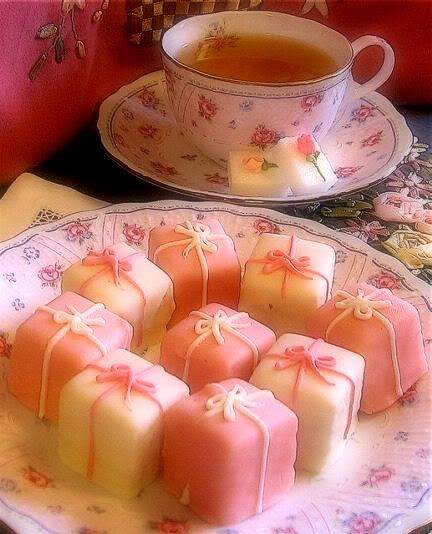
Photograph by Ellen Easton©All Rights Reserved.
Gluhwein
A holiday favorite, mulled tea with red wine. A bit of spicy cloves and cinnamon make this a very sophisticated hot tea cocktail. An alternative to mulled cider.Ingredients:
250 ml strong tea
75 ml sugar
500 ml red wine
5 ml ground cloves
1 cinnamon stick
Rind of 1 lemon
Preparation:
Boil the tea, lemon rind, sugar, cinnamon and cloves together until the sugar dissolves. Add the red wine and bring to a boil. Strain out cinnamon stick and the rind. You may need to add more sugar, to taste. Serve with a slice of lemon.Enjoy!
Monday, June 25, 2012
Cabaret de L'Enfer or Hell's Cafe
www.gothicteasociety.com
Hell's Cafe
A hot spot called Hell's Café lured 19th-century Parisians to the city's Montmartre neighborhood—like the Marais—on the Right Bank of the Seine. With plaster lost souls writhing on its walls and a bug-eyed devil's head for a front door, le Café de l'Enfer may have been one of the world's first theme restaurants.
According to one 1899 visitor, the café's doorman—in a Satan suit—welcomed diners with the greeting, "Enter and be damned!" Hell's waiters also dressed as devils. An order for three black coffees spiked with cognac was shrieked back to the kitchen as: "Three seething bumpers of molten sins, with a dash of brimstone intensifier!"
Tuesday, June 19, 2012
Ask A Mortician - Episode 8
www.gothicteasociety.com
Labels:
Ask a Mortician,
Death,
learn,
mortician.,
Order of the Good Death,
video
Saturday, June 16, 2012
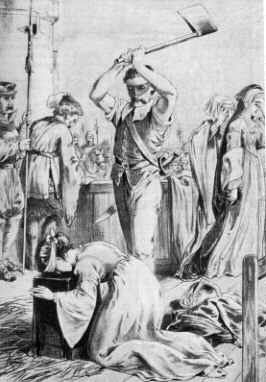
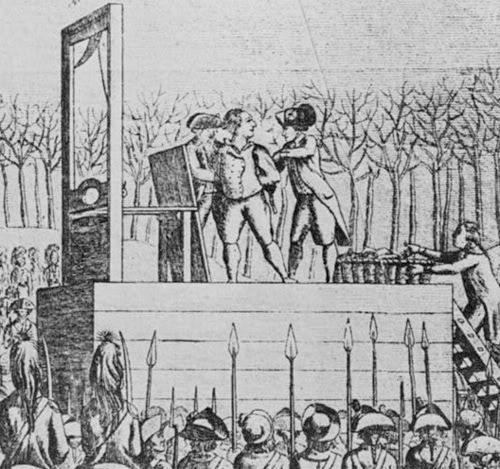
The History of beheading and decapitation

The History of beheading.
Beheading with a sword or axe goes back a very long way in history, because like hanging, it was a cheap and practical method of execution in early times when a sword or an axe was always readily available.
The Greeks and the Romans considered beheading a less dishonorable (and less painful) form of execution than other methods in use at the time. The
Beheading was widely used in
Beheading was used in
Equipment for beheading.
There were two distinct forms of beheading - by the sword and by the axe. Where a person was to be decapitated with a sword, a block is not used and they are generally made to kneel down although they could, if short, be executed standing up, or even sitting in a chair. A typical European execution sword was 36-48 inches (900-1200 mm) long and 2 to 2-1/2 inches (50-65mm) wide with the handle being long enough for the executioner to use both hands to give maximum leverage. It weighed around 4 lbs. (2 Kg.)
Where an axe was the chosen implement, a wooden block, often shaped to accept the neck, was required. Two patterns of block were used, the high block, 18-24 inches (450-600 mm) high, where the prisoner knelt behind it and lent forward so that their neck rested on the top or lay on a low bench with their neck over the block. The neck on a high block presented an easier target due to the head pointing slightly downwards, thus bringing the neck into prominence. It also meant that the axe was at a better angle at that point in the arc of the stroke to meet the neck full on.
The high block was favored in later times in
Some countries used a low block where the person lies full length and puts there neck over the small wooden block which is just a few inches high. This arrangement was used in

Beheading in
In
Beheading was confined to those of noble birth who were convicted of treason and was an alternative to the normal punishments for this crime. Men convicted of High Treason were condemned to hanged drawn and quartered and women to be burned at the stake. In the case of the nobility the monarch could vary these punishments to death by beheading. Beheading was both far less painful and considered far less dishonorable than the normal methods. Several members of Royalty were beheaded, including Charles 1st, Anne Boleyn, Mary Queen of Scots and Lady Jane Grey. Many other Earls, Lords and Knights, including Sir Walter Raleigh. Even some Bishops were beheaded.
The majority of English beheadings took place at the
The spot indicated as "The site of the scaffold" on Tower Green which visitors can see today was not used for all of the 7 private beheadings although the plaque implies this.
Those beheaded in private on Tower Green were Lord Hastings in 1483, Anne Boleyn on the 19th of May 1536, Margaret Pole, Countess of Salisbury on the 28th of May 1541, Catherine Howard and her Lady in Waiting, Jane, Viscountess Rochford on the 13th of February 1542, Lady Jane Grey on the 15th of February 1554 and Robert Devereux, Earl of Essex on the 25th of February 1601.
At various times both the low block and the high block have been used. The axe was the normal implement of execution in
A replica of the scaffold used for the 1601 execution of Robert Devereux, Earl of Essex has been constructed for exhibition in the Tower. The original was set up in the middle of the Parade Ground and was made of oak, some 4 feet high and having a 9 feet square platform (1.2 m high x 2.75 m square) with a waist high rail round it. The prisoner mounted it by a short flight of stairs and was not restrained throughout the execution as it was expected that people of noble birth would know how to behave at their executions! Devereux lay full length on the platform and placed his neck on the low block with his arms outstretched. It is recorded that three strokes of the axe were required to decapitate him. Straw was spread on the scaffold to absorb the blood.The last female execution by beheading was that of 67 year old Lady Alice Lisle who was beheaded for treason at
Beheading in public on Tower Hill was used when the government of the day wished to make an example of the traitor (or traitors). Double beheadings were rare, although not unknown, and were carried out in order of precedence of the victims, as occurred with the Jacobite Earls,
Simon Lord Lovatt became the last person to be beheaded on Tower Hill when he was executed for treason on
The cause of death.
Beheading is as "humane" as any modern method of execution if carried out correctly and a single blow is sufficient to decapitate the prisoner. Consciousness is probably lost within 2-3 seconds, due to a rapid fall of the “intracranial perfusion of blood" (blood supply to the brain). The person dies from shock and anoxia due to hemorrhage and loss of blood pressure within less than 60 seconds. However, because the muscles and vertebrae of the neck are tough, decapitation may require more than one blow. Death occurs due to separation of the brain and spinal cord, after the transection (cutting through) of the surrounding tissues, together with massive hemorrhage.
It has often been reported that the eyes and mouths of the decapitated have shown signs of movement. It has been calculated that the human brain has enough oxygen stored for metabolism to persist for about 7 seconds after the head is cut off.
Beheading requires a skilled headsman if it is to be at all "humane" and not infrequently, several blows were required to sever the head. It took three blows to remove Mary Queen of Scot's head at Fotheringhay Castle in 1587. In Britain, beheadings were carried out by the “common hangman” and were relatively rare so he had very little practice or experience, which often led to unfortunate consequences.
Saudi executioners pride themselves on their skill and efficiency with the scimitar.
The prisoner is usually blindfolded so that they do not see the sword or axe coming and move at the crucial moment. Again, this is why in both beheading and guillotining it was not unusual for an assistant to hold the prisoner's hair to prevent them moving.
In any event, the results are gory in the extreme as blood spurts from the severed arteries and veins of the neck including the aorta and the jugular vein.
All the European countries that previously used beheading have now totally abolished the death penalty.
Friday, June 15, 2012
ART SHOW- West Coast Artists
Thursday, June 7, 2012
Ask a Mortician, Episode 7
Sunday, May 6, 2012
Remember me...
Calm
Have patience, O my sorrow, and be still.
You asked for night: it falls: it is here.
A shadowy atmosphere enshrouds the hill,
to some men bringing peace, to others care.
While the vile human multitude
goes to earn remorse, in servile pleasure’s play,
under the lash of joy, the torturer, who
is pitiless, Sadness, come, far away:
Give me your hand. See, where the lost years
lean from the balcony in their outdated gear,
where regret, smiling, surges from the watery deeps.
Underneath some archway, the dying light
sleeps, and, like a long shroud trailing from the East,
listen, dear one, listen to the soft onset of night.
You asked for night: it falls: it is here.
A shadowy atmosphere enshrouds the hill,
to some men bringing peace, to others care.
While the vile human multitude
goes to earn remorse, in servile pleasure’s play,
under the lash of joy, the torturer, who
is pitiless, Sadness, come, far away:
Give me your hand. See, where the lost years
lean from the balcony in their outdated gear,
where regret, smiling, surges from the watery deeps.
Underneath some archway, the dying light
sleeps, and, like a long shroud trailing from the East,
listen, dear one, listen to the soft onset of night.
Charles Baudelaire
Saturday, April 28, 2012
Burtonesque Gothic Makeup
www.gothicteasociety.com
Subscribe to:
Posts (Atom)